Opinion
Twenty-Three Seconds. That's All It Took.
By David Hole · 30 August 2026
Main story
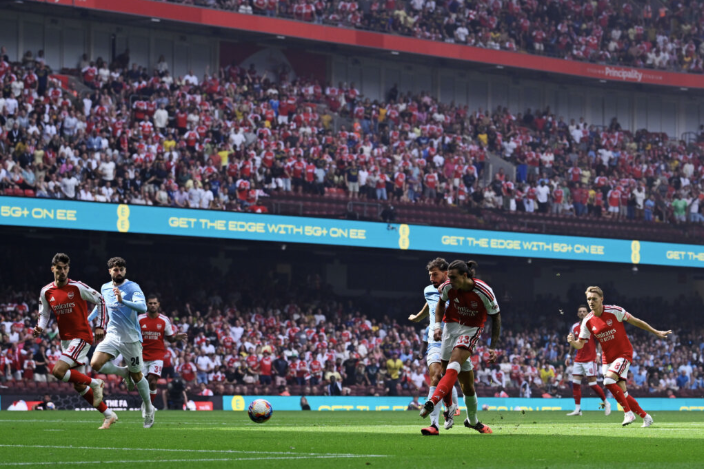
Twenty-three seconds. Riccardo Calafiori hadn't even broken a sweat before he'd buried one past Donnarumma and set the tone for what turned into a Community Shield demolition. Arsenal 3, Manchester City 0. The first goal scored inside the opening minute of a Community Shield since 1968, and a performance so complete that even Enzo Maresca — barely a month into the job — described his own side as "concerningly poor."
Kai Havertz added the second. Martin Ødegaard, with a dummy that left Donnarumma grasping at fresh air, added the third before half-time. Game over. Statement made. And if you're looking for a marker of where this Arsenal side now sits relative to the team that tormented them for the best part of a decade, yesterday's 3-0 felt less like a curtain-raiser and more like a coronation.
Because this isn't the Arsenal of two years ago. This is the Arsenal that ended a 22-year wait for a Premier League title last May. This is the squad that Arteta built — methodically, ruthlessly, and without a single season where you couldn't see the direction of travel. The question now isn't whether Arsenal belong at the top. It's whether they can stay there.
The Squad That Won It — Plus a Few New Faces
Look at the lineup yesterday and the evolution is obvious. Bruno Guimarães sat in the middle of the park like he'd been there for five years, not five weeks. The £87.5 million move from Newcastle was the kind of signing that Arsenal couldn't have made three summers ago — not financially, not in terms of pulling power. Guimarães chose Arsenal over everyone else. That tells you something about the shift.
Noni Madueke started on the right, another statement signing prised away from Chelsea. Cristhian Mosquera slotted in at centre-back alongside Gabriel, the young Valencia defender already looking composed at a level well above his age. And Christos Tzolis, the £34 million arrival from Club Brugge, took up a position on the left of the front three.
That last name is where it gets interesting. But we'll come back to that.
Elsewhere, the squad has been trimmed sensibly. Leandro Trossard left for Beşiktaş. Piero Hincapié's loan from Leverkusen became permanent. Illan Meslier arrived on a free as backup goalkeeper cover. No revolution. Just the kind of targeted, deliberate squad management that has characterised every Arteta window since the early rebuild days. Evolution, not revolution — and that phrase has never felt more fitting than this summer.
What Does a Title Defence Actually Look Like?
Here's the thing about defending a title: it's a completely different animal to chasing one. Every dropped point gets amplified. Every draw at home becomes a crisis. The narrative shifts from "look how far they've come" to "are they slipping?" inside a single bad weekend. Ask Leicester. Ask Chelsea. Ask Liverpool in 2020-21.
Arsenal's advantage is continuity. The core of this side — Saka, Ødegaard, Saliba, Rice, Gabriel, Raya — has been playing together long enough that the patterns are instinctive. Arteta doesn't need to teach a new system. He needs to keep the existing one sharp and make two or three marginal upgrades that keep the squad ahead of the chasing pack.
City are still there, obviously. They always are. Haaland isn't going anywhere, and their depth remains absurd even after the upheaval of Guardiola's departure and Maresca's appointment. But yesterday suggested something: this City side, in transition, isn't the side that won four in a row. They looked disjointed. They looked like a team that doesn't quite know what it is yet.
Liverpool are the other genuine threat. A strong squad, a manager who knows the league, and the kind of squad depth that can sustain a title challenge across a full season. But Arsenal have something neither rival currently possesses — a settled identity and a group of players who know exactly what's expected of them. That's worth more than any individual signing.
The Left Side: Arsenal's One Unresolved Question
And now the bit everyone wants to talk about.
The left of Arsenal's forward line has been the one persistent weakness in an otherwise elite squad for the best part of two seasons. Martinelli and Trossard did enough. They contributed. They weren't a liability. But "did enough" is not the same as matching the level that Saka sets on the right, and it's not the same as providing the kind of one-on-one threat that stretches compact defences and creates the space that Ødegaard and Havertz need to operate.
Arsenal knew this. Morgan Rogers was the number one target — Fabrizio Romano confirmed as much. An England international, 10 goals and 6 assists for Aston Villa last season, and the kind of direct, powerful runner that Arsenal's left side has been crying out for. Arsenal talked to Villa for weeks. And then Chelsea walked in last Thursday with £117 million and took him.
That hurts. There's no dressing it up. Rogers was the profile that solved the problem, and Arsenal's hesitation — whether on the fee, the structure, or the speed of decision-making — cost them. Bradley Barcola at PSG was reportedly the backup option, but nothing has materialised there either.
So where does that leave us?
Martinelli starts the season. He started yesterday. He's still here because Arsenal won't sell without a replacement, and no replacement at the required level has been secured. Galatasaray have been sniffing around. There are reports that Martinelli himself wouldn't mind a new challenge. But with Trossard gone and Tzolis — for all his energy — not yet at the level required to be a regular starter for a title-defending side, Martinelli is it. By default rather than design, perhaps, but he's it.
And here's where I'll take a position: Martinelli can still be the answer. Not the long-term, five-year answer. But for this season, with the right support from Calafiori overlapping behind him and Guimarães feeding the channels, there's enough there to make it work. His pressing is elite. His movement is sharp. What he lacks is the consistency of end product — the goals and assists tally that should be higher for a player of his athleticism and ability.
This is the season where Martinelli either proves he belongs at this level or confirms what the numbers have been quietly suggesting: that Arsenal need an upgrade. The club will almost certainly revisit this position in January or next summer. But right now, the left side of the forward line is Martinelli's to own or lose.
Tzolis will get minutes. He's a useful squad option — a Trossard-type profile who can play across the front line and offer something different as an impact substitute. But he's not the solution. He's the depth that allows Arsenal to manage Martinelli's workload while the search for a long-term left-sided forward continues.
So, Can They Do It Again?
Yes. Not comfortably, not inevitably, but yes.
The spine is elite. The recruitment this summer — Guimarães, Madueke, Mosquera — has strengthened the areas that needed strengthening. The manager knows what he's doing and has the trust of the dressing room. The mentality shift from nearly-men to champions is the hardest part, and that's already done.
The left wing remains the gap. If Arteta can extract a genuine 15-goal, 8-assist season from Martinelli — or find an alternative in January — Arsenal retain the title. If that position continues to underperform relative to the rest of the squad, it becomes the crack that City or Liverpool exploit over 38 games.
Twenty-three seconds yesterday. That's how quickly this Arsenal side can hurt you. The question is whether they can do it consistently from both flanks, not just the right. The answer to that question is the difference between defending the title and surrendering it.