Opinion
The Martin Show.
By David Hole · 30 August 2026
Main story
Champions Do This. That's the Difference.
Coventry City didn't make a tackle in the first half. Not one. In forty-five minutes of Premier League football, the newly promoted side couldn't get close enough to an Arsenal player to put a foot in. Opta have been tracking this data since 2007. It has never happened before.
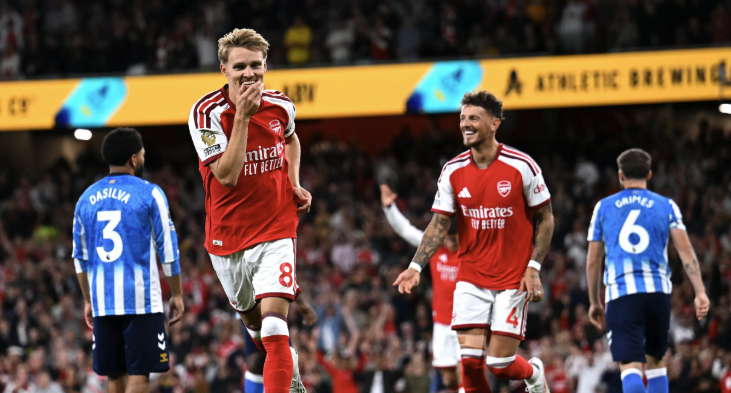
Arsenal 3, Coventry 0. Havertz on fifteen minutes, Saka on twenty-three, Ødegaard four minutes into the second half. Game effectively over before the floodlights had earned their keep. And the thing that stood out more than any individual goal, any individual performance, was the feel of the whole thing. This is what champions look like when they know they're champions. There's a looseness to it — a confidence that doesn't tip into arrogance but sits just above effort. Everything a fraction quicker, a fraction more certain, a fraction more ruthless than it was twelve months ago.
That's the 10% that wins you titles back to back.
The Weight of the Badge
There's a moment in every title defence where you find out whether the squad has absorbed the winning or whether last season was the peak. It usually comes in the first few weeks — a flat performance, a sluggish start, the hangover of a summer spent being told how good you are. Arsenal didn't just avoid that. They crushed it.
From the first whistle, the Emirates felt different. Not louder, necessarily, but more assured. The crowd knew what was coming. The players knew what was coming. And Coventry — brave, freshly promoted, genuinely delighted to be there — knew it too. Frank Lampard, to his credit, was honest about it afterwards: "It was a big learning curve." He's not wrong. But this wasn't really about Coventry. This was about Arsenal showing that the mentality they built across three years of near-misses and one glorious breakthrough hasn't softened over the summer. If anything, it's hardened.
Arteta's 150th Premier League win, reached in fewer than 250 matches. That's elite company. And the way the side played on Friday night suggested the next 150 won't take anywhere near as long.
Tzolis: Not the Answer, But Maybe Part of It
The most encouraging subplot was Christos Tzolis. The £34 million signing from Club Brugge made his Premier League debut on the left and played like he'd been waiting for it his whole career. Four shots, eight touches in the opposition box, three chances created — and direct involvement in the first two goals. He won the ball back for Havertz's opener and delivered the cross that led to Saka's second.
Arteta called him "phenomenal." He talked about loving a player who, after only a few weeks at the club, brings "this kind of energy every time he's on the ball." He described Tzolis as "so direct, so incisive, constantly" and praised an "incredible variety of actions in the last 30 metres."
Now, let's keep perspective. This was Coventry on their first night in the Premier League. The step up from the Championship is enormous, and Tzolis won't face many sides this accommodating. But what he showed was intent — the willingness to run at people, to take the half-yard and do something with it, to stay involved rather than drifting through games. Those are the qualities that Arsenal's left side has lacked. Whether Tzolis can sustain them against sides that actually defend remains the question, but as a first impression, it was hard to fault.
He's not going to be the long-term solution that Morgan Rogers would have been. But if he can contribute 8-10 goals and a handful of assists while maintaining that energy and directness, he buys Arteta time. Time to find the elite left-sided forward in January. Time to let Martinelli — who wasn't even in the matchday squad — decide whether he fights for his place or accepts that the direction of travel has moved past him.
The Right Side Is Just Unfair
If the left side provided the subplot, the right side provided the quality that actually kills games. Ben White, Saka, and Ødegaard operated through that channel like they've been doing it in their sleep — because, at this point, they have. The understanding between those three is telepathic. White overlaps, Saka receives, Ødegaard arrives late into the half-space. Teams know it's coming. They still can't stop it.
Saka's goal was the moment of the night. The combination play that created it was everything Arsenal do well compressed into five seconds — quick feet, one-touch movement, and a finish that Coventry's goalkeeper got a hand to but couldn't keep out. It's the kind of goal that demoralises opponents not because of its brilliance, but because of its inevitability. You could see it developing three passes before it arrived, and there was nothing Coventry could do about it.
Ødegaard's goal early in the second half was the full stop on the performance. A captain's goal — composed, clinical, and timed to kill any faint hope of a comeback before it could form. Arteta talked about wanting to "flow with the ball" and to "connect well with one another." When Arsenal are in this mood, that connection is seamless.
The Midfield Control
Rice and Lewis-Skelly sat at the base of midfield and controlled tempo without breaking stride. Rice, back from England's summer exertions, looked sharper than anyone had a right to expect — recycling possession quickly, covering the spaces behind the press, and releasing the ball forward early enough to catch Coventry's shape before it could set. Lewis-Skelly, still only a teenager, played with the composure of someone who's been doing this for years. The pair barely gave Coventry a sniff of the ball in central areas.
With Guimarães waiting in the wings — the £87.5 million summer signing from Newcastle didn't feature — Arsenal now have genuine depth and competition in the middle of the park. That's a luxury they didn't have twelve months ago, and it's the kind of squad strength that sustains title defences through the winter months when fixtures pile up and legs get heavy.
What the 10% Looks Like
There's a temptation to dismiss a 3-0 win over newly promoted opposition as routine, and in one sense it was. Arsenal should beat Coventry at home. They should beat them comfortably. The scoreline tells you nothing you didn't already know about the gap between the sides.
But the manner tells you something about Arsenal. Watch the pressing — it's tighter than last season, more co-ordinated, with fewer moments where the front line presses but the midfield doesn't follow. Watch the speed of circulation — the ball moves quicker, the transitions sharper, the midfield dictating rather than reacting. Watch the body language — there's no tension, no anxiety, just the calm certainty of a group that has done this before and knows it can do it again.
That's what the champions' vibe looks like in practice. It's not a radical transformation. It's not a different system or a different philosophy. It's the same Arsenal, playing the same way, but with the weight of a title behind them instead of the desperation of chasing one. The decisions are a fraction better. The composure under pressure is a fraction higher. The ability to manage games — to kill them at 2-0 rather than sweating at 1-0 — is a fraction more reliable.
A fraction, across 38 games, is the difference.
Aston Villa away next. That's the first proper examination. But on Friday night, under the Emirates lights, with the champions' banner hanging above the pitch for the first time, Arsenal looked exactly like what they are: the best side in the country, and getting better.