Opinion
Ten Games In: Where Arsenal's Title Defence Really Stands
By David Hole · 10 November 2026
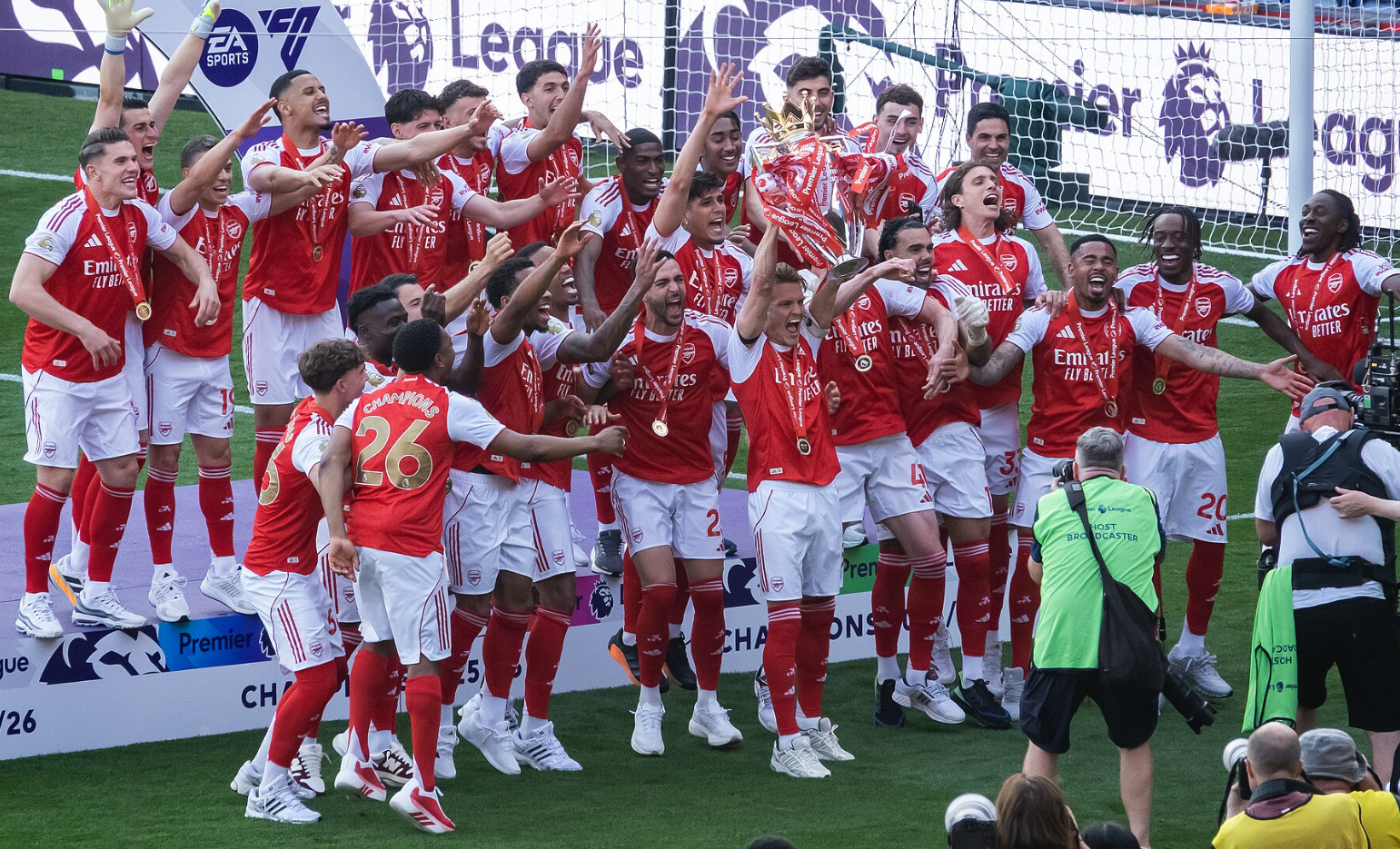
Ten Games In: Where Arsenal's Title Defence Really Stands
Ten Premier League games, four in the Champions League, one humiliating night in Lancashire. That's the first quarter of Arsenal's title defence, and it's produced a team that sits six points clear at the top of the league, unbeaten in Europe, and out of the Carabao Cup at the hands of a side 18th in League Two.
Every one of those things is true at once, and the international break is the right moment to take stock of all of them: what the results actually say, what the cup exit changes, who's injured, who isn't playing and why, and what the next five games could do to the shape of the season.
The League: Results Ahead of Performances
The raw numbers are excellent. Twenty-seven points from ten games. Nine wins, one defeat. Seven clean sheets. Only five goals conceded. Only four sides in Premier League history have had more points at this stage, and only three have kept more clean sheets.
Here's how it's been built:
1. Coventry (H) — W 3-0
2. Aston Villa (A) — W 1-0
3. Chelsea (H) — W 2-1
4. Sunderland (A) — W 2-0
5. Brighton (A) — L 0-3
6. Leeds (H) — W 2-1
7. Nottingham Forest (A) — W 1-0
8. Everton (H) — W 2-0
9. Liverpool (A) — W 1-0
10. Hull City (H) — W 1-0
Look down the right-hand column and the pattern is obvious. Six of the nine wins came by a single goal. Arsenal have scored 15 times in ten games, which is a modest return for a side sitting top of the table. Since the Brighton defeat in September — a 3-0 hammering that ended the perfect start and was the club's first league defeat since April — they've won five straight, four of them 1-0 or 2-1, and kept four consecutive clean sheets.
The pros. The defence is the best in the country and maybe the best Arsenal have had. Gabriel and Ezri Konsa have been outstanding, Raya has barely been tested, and the side has won at Villa Park, the City Ground and — for the first time in 14 years — Anfield. Wins away at difficult grounds without playing well are the hardest thing to do in a title race, and Arsenal are doing it routinely. They've also won ten home games in a row in all competitions.
The cons. The attack hasn't caught up. Against low blocks — Forest, Hull, Leeds for an hour — Arsenal have struggled to create clear chances, and Mikel Arteta said after Hull that his side are trying too hard to score the perfect goal rather than taking the good ones. When you win by one goal, one deflection or one missed penalty decision decides your weekend. The margin for error is very thin.
The implications. Arsenal have banked a six-point lead without hitting top gear. That's the good version of the story. The less comfortable version is that their goal difference (+10) doesn't scream dominance, and if the defence has a bad month, there isn't a scoring cushion behind it.
Scenarios.
Best case: Saka returns, the attack starts converting the volume Arteta keeps talking about, and the 1-0s become 3-0s. With this defence, that's a side that could run away with the league by Christmas.
Most likely: More of the same — narrow wins, a draw or defeat here and there, and the lead fluctuating between three and six points into the new year.
Worst case: The defence has a wobble, the attack doesn't compensate, and a run of draws against deep blocks hands City or another chaser a way back in.
The Champions League: The Hard Part Is Done
Four games, ten points, and three of the four away fixtures already out of the way.
Napoli (A) — won 1-0
Lille (H) — won 3-0
Bayern Munich (A) — drew 2-2
Slavia Prague (A) — won 2-1
The 2-2 at the Allianz Arena was the standout. Eberechi Eze, on early for the injured Saka, put Arsenal ahead; Alphonso Davies equalised; Harry Kane scored a penalty — of course he did — and Declan Rice equalised with eight minutes left. Leaving Munich with a point and a performance that matched Bayern's was a statement.
The pros. Arsenal's remaining league-phase fixtures are Borussia Dortmund at home on 24 November, Real Madrid at home on 9 December, Real Betis away on 20 January and Sabah at home on 27 January. Three of the four are at the Emirates. In the format's first season, 16 points was enough to finish eighth and qualify automatically for the last 16. Arsenal need six more to reach that mark from four games.
The cons. Two of the three remaining home games are against Dortmund and Real Madrid. They're not banker wins, and they're sandwiched between the biggest domestic fixtures of the autumn.
The implications. A top-eight finish means skipping the knockout play-off round in February. That's two fewer high-intensity games in the worst part of the calendar. For a squad that has had the injury problems this one has, that matters a lot.
Scenarios.
Best case: Wins over Dortmund and Sabah, and a top-four finish in the league phase, which brings home advantage in the second leg of each knockout round.
Most likely: Comfortable top-eight qualification, with the final position decided by the Madrid and Betis results.
Worst case: Defeats to Dortmund and Madrid, a nervy January, and a slide into the play-off round. Unlikely from ten points, but not impossible.
The Carabao Cup: Humiliation With a Silver Lining
There's no dressing up what happened at Highbury Stadium on 27 October. Fleetwood Town, 18th in League Two, took the lead through Aaron Loupalo-Bi. Viktor Gyökeres equalised early in the second half. Max Dowman was sent off with five minutes left for kicking out at Harrison Neal. Fleetwood scored all five of their penalties; Bruno Guimarães had his saved. Fleetwood won 5-3 on penalties, and Arsenal were out of a competition they'd reached the final of last season, when they lost 2-0 to Manchester City.
It's one of the biggest shocks in the competition's history. It's also, in purely practical terms, not the worst thing that could have happened.
The pros. The fixture calendar. The quarter-finals are played in the week of 14 December. The semi-finals are two-legged, in the weeks of 11 January and 1 February. The final is on 21 March. A side that went all the way would have played four more games, three of them in December, January and February — exactly when the Premier League, the Champions League and the FA Cup collide. That's the slight easing in the new year: no two-legged semi-final, and a free midweek in mid-December, right after the Real Madrid game.
The cons. It's a trophy gone. Arsenal lost last season's final and won't get another shot this year. The League Cup is also where fringe players get meaningful minutes. Without it, Arteta loses one of the few places he can give game time to Dowman, Gyökeres, Zubimendi and others without risking league points.
The implications. Arteta will gain recovery time, but he'll need to find minutes for his squad players elsewhere — most likely in the FA Cup and the lower-stakes Champions League games in January.
Scenarios.
Best case: The freed-up midweeks keep key players fresh through the winter, and Arsenal are stronger in March and April than their rivals who are still in four competitions.
Most likely: A modest benefit that's hard to see in any one game but adds up over the season.
Worst case: Fringe players lose sharpness, and when injuries hit, the replacements aren't match-ready.
Injuries: Saka Out, Saliba Close
Bukayo Saka is the big one. He went off in the tenth minute against Bayern on 21 October with a quadriceps injury and hasn't played since. Before the Hull game, Arteta said he'd be out for several more weeks with no return date set, and that the club didn't want to rush him back. The realistic expectation is a gradual return to training after the break, which puts him in doubt for most, if not all, of the next five games.
Madueke has stepped up superbly in his absence. But Saka is the player opponents set up to stop, and his absence is a big part of why Arsenal's attack has looked short of ideas against deep defences.
William Saliba hasn't played a minute this season. He suffered a back injury in France's World Cup semi-final against Spain in July and returned to full training on 3 November. He's the most important player Arsenal are about to get back.
Other problems have cleared up. Jurriën Timber missed the start of the season with a groin injury but is now playing regularly. Christos Tzolis had a hamstring problem in early October and returned. Zubimendi and Piero Hincapié both picked up ankle injuries after the Leeds game in October; Hincapié returned at Fleetwood.
Pros and cons of Saliba's return.
For: Arsenal get a world-class defender back for the hardest run of the season. His partnership with Gabriel won the league, and his composure on the ball under pressure is a big part of how Arsenal build from the back. Having three top-class centre-backs for City, Madrid and two London derbies is a luxury.
Against: Konsa has been excellent. Against Hull he won all seven of his duels and completed 51 of his 53 passes, and he's scored this season too. Dropping him would be harsh, and the defence hasn't conceded in the league since the Leeds game on 10 October. There's also the risk of rushing a player back from a back injury after four months out — the worst outcome would be a setback in December.
Scenarios.
Most likely: Saliba is eased in through the Dortmund game or as a substitute in the league, with Konsa keeping his place for Newcastle. By the Brentford and Spurs games, Arteta has a genuine selection call.
Best case: Saliba is back to his level by December, Konsa covers at right-back when needed, and Arsenal have the deepest defence in the league.
Worst case: Saliba isn't ready, Konsa or Gabriel picks up a knock, and Arsenal go into City and Madrid with a makeshift back line.
The Players Who Aren't Playing
This is the part of Arsenal's season that's had the least attention and could matter most by January.
Martín Zubimendi has gone from first-choice holding midfielder in the title-winning season to an afterthought. He'd played just 89 minutes across the first five league games, and by early November he had six league appearances, all from the bench, adding up to around 100 minutes. Guimarães has taken his place alongside Rice, and Ødegaard ahead of them isn't moving. Zubimendi has said publicly that the situation isn't ideal, and there have been reports of interest from abroad ahead of January.
Viktor Gyökeres has had a similar autumn. Kai Havertz is first choice at centre-forward. In the first five league games Gyökeres played just 19 minutes out of a possible 450, and his minutes since have mostly come off the bench, in the Carabao Cup and in the Champions League. He has scored — the equaliser at Fleetwood and Arsenal's second goal in Prague — and there have been reports the club would listen to offers.
Max Dowman, still only 16, has had the most complicated few weeks of anyone. He's been trusted with minutes, including a substitute appearance against Everton, but his red card at Fleetwood brought a three-match domestic ban. Arsenal's appeal was rejected, and he's serving it through the Liverpool, Hull and Newcastle games. The suspension doesn't cover European games, so he's available for Dortmund.
Piero Hincapié lost time to an ankle injury in October and has been behind Riccardo Calafiori at left-back. He's back fit, but first-choice minutes are hard to come by.
The pros. This is what depth looks like. A title-defending squad that can leave Zubimendi and Gyökeres on the bench is a squad with real options, and when the injuries come — and they always do — Arteta has players of genuine quality to call on. It also keeps the first XI honest. Nobody's place is guaranteed.
The cons. Players who don't play get rusty, frustrated, or both. Zubimendi and Gyökeres were significant signings with significant price tags. If their minutes don't improve, January becomes a real risk — either losing a quality player mid-season or keeping one who's unhappy. Dowman's case is different: his development needs minutes, and a suspension plus a cup exit removes two of the most natural places to get them.
The implications. How Arteta manages these players through December could decide whether his squad is still deep in March. The Champions League dead rubber against Sabah in January and the early FA Cup rounds are the obvious places to give them minutes.
Scenarios.
Best case: Rotation through the congested December run gets Zubimendi and Gyökeres back into rhythm. Both contribute, both stay, and Arsenal benefit from that depth in the spring.
Most likely: Minutes increase a little out of necessity, but one of the two — most likely Zubimendi — remains a January talking point.
Worst case: An unhappy player forces a January exit, and an injury elsewhere then exposes the gap that's been created.
The Next Five Games
After the break, Arsenal play five times in 15 days:
Sat 21 Nov, 5.30pm — Newcastle (A), Premier League
Tue 24 Nov, 8pm — Borussia Dortmund (H), Champions League
Sun 29 Nov, 4.30pm — Manchester City (H), Premier League
Wed 2 Dec, 8pm* — Brentford (A), Premier League
Sat 5 Dec, 3pm* — Tottenham (A), Premier League
*Standard slot as listed by Arsenal; December kick-off times may still move for TV.
Real Madrid come to the Emirates on Wednesday 9 December at 8pm, four days after the derby.
Newcastle away. St James' Park is never easy, and Newcastle will press and attack rather than sit deep. That might actually suit Arsenal better than Hull did. Dowman is suspended, and Saka almost certainly won't be back.
Dortmund at home. A win here would put Arsenal on 13 points in the Champions League and very close to the top eight. It's also the natural place for Saliba's first minutes, and for rotation ahead of City.
Manchester City at home. The biggest game of the autumn. City are second, six points behind. Whatever the gap is by then, a win stretches it by three and a defeat cuts it by three — and if City have closed in over the previous week, that could turn the title race into a sprint.
Brentford away. A Wednesday night in west London, three days after City. A classic potential banana skin, especially if legs are tired.
Tottenham away. The north London derby, three days after Brentford. Derbies don't care about form tables.
The pros. Arsenal go into this run six points clear, with Saliba coming back and the defence in the best shape it's been in all season. Four of the five opponents will come at them rather than sit deep, which may suit them better.
The cons. The schedule is brutal. Five games in 15 days, against the second-placed side, a Champions League contender and two away London derbies, without Saka and with Dowman out for the first of them.
Scenarios.
Best case (12 league points from 12): Wins at Newcastle, Brentford and Spurs plus a win over City, a Champions League win over Dortmund, and Arsenal head into the Madrid game with the title race firmly in their hands.
Most likely (7–9 league points): Two or three wins from the four league games, Arsenal still top at the end of the run, with the size of the lead depending on City's own results.
Worst case (4 points or fewer): Defeat to City, dropped points at Brentford or Spurs, and a lead that's gone or nearly gone by the time Madrid arrive.
The Verdict
Arsenal's first ten games have been better in results than in performances, and that's not a criticism. Title-winning sides find ways to win when they're not playing well, and this one keeps finding them. The defence is elite. The squad is deep enough to leave quality players out. And the Carabao Cup exit, embarrassing as it was, gives Arteta a little more breathing space in the new year.
But the next five games will test every part of that. The attack has to start turning control into goals. Saliba has to come back without a setback. And the players who've been on the margins — Zubimendi, Gyökeres, Dowman, Hincapié — need to be ready, because a run like this is exactly when they're needed.
Six points clear with City at home in three weeks' time. That's a very good place to be. It's also the point where the title defence stops being about how well Arsenal have started and becomes about how well they can hold on.